Trigesimus Octavus Gradus
Inspired by and dedicated to my sister, whose imagination and creative talent far surpass my own. The event and characters are derived from a post she shared on 10 November 2021.
Black branches cut through the gray sky. They divided up the clouds like tight paint strokes, hiding the sky behind masses of tiny twigs. The naked trees swayed to and fro in waves that rippled through the forest, bending under the graceful wind above her head. She was a blot of color in the drab, dry forest. Her head was lush and bright, grown symmetrical. It was, of course, a pumpkin. Her eyes and mouth were jagged like puzzle pieces removed from the flesh of her head, leaving holes the color of a stormy night sky in their place. Yet, now and again, if one looked closely, one would see a faint yellow-orange flicker paint that black canvas. She frolicked among the sturdy trunks, crushing piles of dead leaves below her bare, pale feet. Her path was sure and confident, erratic and relaxed. She paid no mind to the biting wind. Her body was shrouded in a simple white gown with orange frills.
The young woman slowed before a wall of tightly-wound trees whose branches thrashed violently against each other. Instead of trailing behind her, her gown now flared in all directions. The cyclical gale was deafening in this place, where before the breeze was a soothing melody.
With one step forward, the wall of trees creaked, the gale whistled to a slower pace, and a gap in the branches emerged. She slipped through, entering a glade, and the gale resumed behind her, closing the trees.
Inside the perfect circle of trees there was no noise. The air was still. The overcast sky was clear of branches, but the clouds were giant foaming bubbles, no longer a flat blanket. No dead leaves hid the ground. Instead, healthy green vines snaked through the glade. She walked over yellowed grass toward the center of the circle.
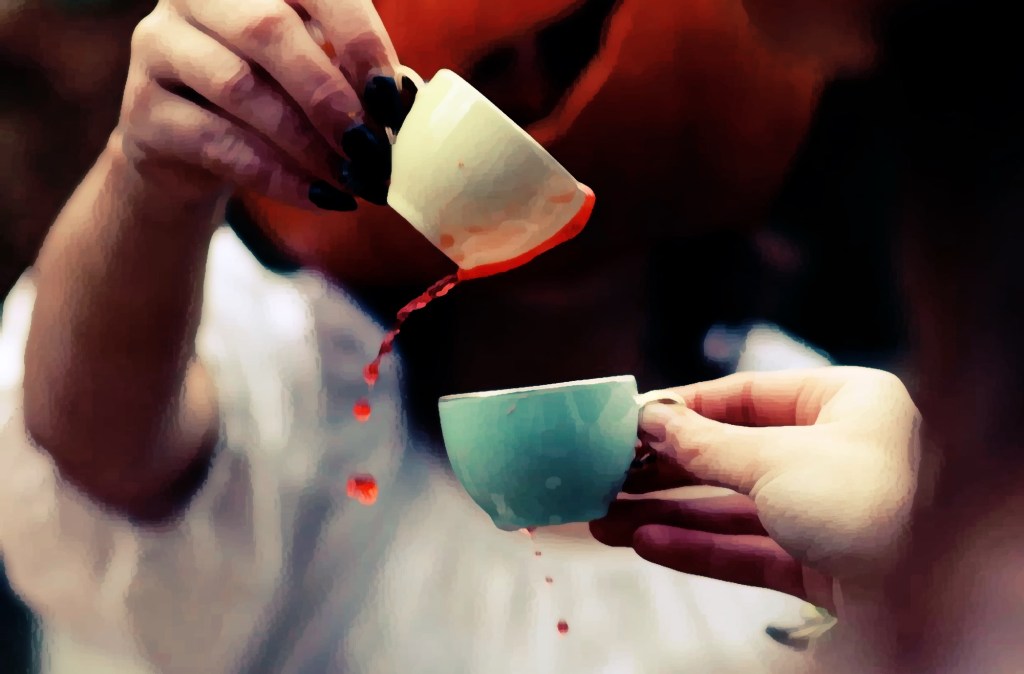
There rested a white table, upon which waited a porcelain tea set of various pastel colors. Its metal frame was crafted with elegant shapes woven together. Two chairs on either side matched its style. One of them was occupied by another woman who sat with legs crossed, saucer in hand. A porcelain teacup rested against her lower pumpkin lip, pouring a thin stream of bright red tea into her mouth. Curled beneath her chair, with his eyes shut gently, his body rising and falling with deep breaths, slept a fox. The fox’s fur was groomed as if by an angel, his hue a perfect match for his owner’s pumpkin head. The black gloves over his paws and up his forelegs gave him a regal appearance even while he slept like a newborn pup.
The woman turned toward the newcomer. She smiled sweetly and gestured to the empty chair, which slid away from the table and rotated toward the younger woman.
“Welcome to my pasture, Nuala,” the woman’s dark mouth flickered that yellow-orange more rapidly as she spoke, its glow pawing at the lower edges of her eyes.
“Thank you for inviting me, Lady Lavendera,” Nuala responded with a curtsy before taking her seat. As the chair pulled itself back in to the table she folded her legs in the same way as Lavendera.
“I know you haven’t much time before Lord Fraxinus” (Nuala’s fiancé, as it were) “arrives. So, allow me to—oh, dear! I’ve not offered you a cup,” Lavendera chided herself. “Tea?” Nuala smiled, nodding.
The Lady’s movements as she curled her pale fingers around the teapot, raised the teapot, tilted the teapot, then set it down and handed the saucer and teacup to Nuala, were serene. Every elegance of nature permeated her actions. There was no flicker of hesitation in them. Nothing to betray the ongoing self rebuke that Nuala knew Lavendera was issuing, berating herself for forgetting to pour the tea before speaking.
Why was she so distracted and uptight, so rigid in spirit? What was she going to say? Nuala blinked and stared at the spout, certain she would not find the answers in Lavendera’s eyes.
As she poured, Lavendera held the teapot so still that the bright red tea poured so smooth as to be mistaken for a glass sculpture. Even the pale light of the glade refracted through the liquid and painted the tablecloth with rosy, motionless patterns.
The tea steamed as Nuala held the cup in her hands before her mouth. It smelled not unlike a rosebush, not unlike a rain-drenched strawberry in the first sunshine after a storm. It tasted not unlike those things, either, but many more flavors worked in tandem with them.
“Is the tea hot enough?” Lavendera sat forward.
Removing her lips from the edge of the cup, Nuala answered, “yes, and it is delicious. Did you add a cherry blossom this time?”
Lavendera folded her hands into her lap. Nuala shivered; the Lady was ready for conversation. What transgression have I committed to be ridiculed in person? In her pasture, no less! What Nuala once thought an honor was becoming a horror wrought by her own deficiency.
“Why,” Lavendera started with cheer, “indeed I did. You have a fine palate, dear.”
Nuala was going to offer her thanks, then bring attention to the dewdrop accent as well, to spend more time discussing the tea and less time discussing whatever Lavendera had on her mind. But Lavendera spoke too soon.
“Nuala, I summoned you here to express my gratitude.”
Your gratitude? Nuala’s eyes expanded, the pumpkin flesh wrinkling at the edges.
“In all the years I’ve been their stewardess my acres have never been better kept. Your enchantments and mundane efforts far surpass those of my peers of nobility—” this word she said with poison on the tongue— “whose lands are shabby wilderness compared to mine. Never have I met a more brilliant and honest Keeper. The Lords and Ladies are jealous that I have you in my employ. Rightly so.” She paused, her smile gleaming at Nuala. Her face grew stern as she continued. “I only hope that I have proved myself to be a master deserving of your talents and heart.”
The fox beneath the Lady’s chair cooed.
“I pray this winter has been a fulfilling rest that your good work would continue into the next growing season.” Lavendera paused to take a draw of tea. “I want you to know, Nuala, that anything you need of mine, whether for my purposes or your own, is yours. You need only alert me.”
The Lady turned her attention to her fox, who leapt onto her lap and nestled in. She looked over the table at Nuala and fell silent, now and again drinking tea. Her eyes remained set on Nuala, but they did not press for an answer. They were kind, patient.
Nuala raced for an answer, her head spinning. She planted a hand on the table to steady herself. The motion seemed unnecessary, for she was sat upright and polite, perfectly stoic. Her throat clenched, her eyes stung. What is the matter with me? What do I say to her?
She breathed, the glade’s pure air flooding her lungs.
“Lady Lavendera, the honor is all mine. In fact it is not by my—”
“Please. Do not take me as a fool. I can see the fruits of your labor,” the Lady smiled a punctual sort of smile, as if she would hear no more on the topic.
With all her heart, Nuala wanted to protest. She took a breath, and understood; she relaxed. “Cheers?” Nuala held out her cup, the tea inside brushing against the rim.
“Cheers!” Lavendera laughed, clapping her cup against Nuala’s. The tea sloshed over the edge, falling in peculiar spheres to the table and grass.
“Has Mister Verner caught up on his wife’s den projects, yet?” Nuala asked of the fox. Lavendera laughed heartily while the fox snickered. She refilled her cup as she said, “Mister Verner couldn’t finish her projects if he had a kingdom to command.”
The trio were merry for some moments, held aloft in that glade by their glad spirits. Mister Verner left Lavendera’s lap to stretch. As the conversation grew he pranced about or stood on his hind legs with paws on the table. Tea spilled over the cups as the women swung their arms in laughter without reserve; a formal mood at tea time is scarcely appropriate. The green and pink and pale blue teapots and saucers and sugar cups added to the jest.
The whirling wall of trees slowed. A sliver in their ranks, far taller than the one which had opened for Nuala, appeared. Through it emerged a black stallion. As he trotted into the glade Nuala’s chair spun away from the table. The rider bent over, placing a hand at Nuala’s waist and hoisting her up with the momentum of the horse. A dark aura surrounded the rider’s body like an inverted vignette. He wore a Victorian suit fitting for a nobleman, each piece black like his horse except the ivory shirt. The shirt was clearly intended as the focal point of the man, as Nuala, in her white gown, became the focal point of the stallion and its burden. The flesh above the rider’s collarbone—neck and all—was naught.
“Lord Fraxinus! Welcome to my pasture,” Lavendera gestured over the glade.
Fraxinus, in a motion invisible to any eye, tucked his harness straps onto hooks affixed to his jacket sleeves, then signed a message to the Lady. She smiled and nodded. He unhooked the straps effortlessly and snapped them, ushering his stallion out of the glade. As they departed, Nuala shouted, “thank you for everything, my Lady!”
The stallion was swift. Nuala could barely hear Lavendera’s message as they approached the edge of the glade.
“Fare well, Nuala! I pray the gifts in wait for you at your abode find you well.” Lavendera waved until the trees closed and the cyclical wind wound up behind them.
 Parva Gradus